
Reverse Flow vs Offset Smoker
A reverse flow smoker is an offset smoker with a different heat path, not a different cooker. The baffle plate sends heat under the grate to the far end, then back over the food.
The whole grate cooks at nearly the same temperature. A traditional offset sends heat straight across, so the firebox end runs hot and the far end runs cool.
Pick reverse flow if you fill the whole grate and want everything to finish together. Pick traditional if you like working the zones.
As an Amazon Associate, JuicyBurn earns from qualifying purchases made through links on this page, at no extra cost to you.
JuicyBurn has not cooked on these layouts side by side. This comparison is built from manufacturer specifications, Amazon listing details, and what owners say in reviews, forums and roundups. We do not claim test results we do not have, and we do not print star ratings or review counts. Last updated November 28, 2026.
Reverse flow wins on even heat across a full grate. Traditional wins on working the zones and the strongest direct-fire flavor. For most backyards, start with the Highland if you like a hands-on cook, or the Longhorn Reverse Flow if you fill the whole grate. Both Oklahoma Joe’s reverse-flow picks can also run as a traditional offset by moving the baffles and the smokestack.
Reverse Flow vs Offset Smoker at a Glance
| Traditional offset | Reverse flow offset | |
|---|---|---|
| How heat moves | Straight across the chamber, firebox end to a stack at the far end | Under the grate on a baffle plate to the far end, then back over the food to a stack on the firebox side |
| Where the stack sits | At the far end, away from the firebox | On the firebox side |
| Heat pattern | Hot at the firebox end, cooler at the far end | Even across the whole grate, by design |
| Flavor and bark | Strongest direct-fire flavor and bark, by reviewer and builder consensus | Very close, and more even across the grate |
| Cooking zones | Two zones: a hot end and a cool end | One even zone across the grate |
| Ease of use | Rewards a hands-on cook who works the zones | Load the whole grate and everything finishes together, less shuffling |
| Temperature control | Two dampers and fire management, learned over time | Two dampers and fire management, learned over time |
| Cooking area (our picks) | 430-879 sq in | 1,060-1,093 sq in |
| Fuel use | Charcoal and wood splits; same firebox, same fuel | Charcoal and wood splits; same firebox, same fuel |
| Cleaning | Empty the ash pan and clean the grates | Empty the ash pan and clean the grates, plus the baffle plates |
| What you need to run it | Charcoal, wood splits, a chimney starter | Charcoal, wood splits, a chimney starter |
| Best for | One or two big cuts, working a hot end and a cool end | A full grate of same-size pieces that should finish together |
| Weakest point | The far end cooks slower than the firebox end | Baffle plates add steel, cost and cleaning |
How Does the Heat Path Actually Differ?
Short answer: a traditional offset sends heat straight across the grate in one pass. A reverse flow sends it out under a baffle plate and back over the food.
A reverse flow smoker is an offset smoker, not a separate kind of cooker. The firebox, the fuel and the chamber are the same kind of pit. Only the heat path changes. In a traditional offset, heat and smoke cross the chamber once, from the firebox end to a stack at the far end. In a reverse flow, a baffle plate under the grate sends the heat the length of the chamber, it turns at the far end and comes back over the food to a stack on the firebox side. That is the reverse flow smoker vs offset difference in one sentence: one pass across the grate, or out and back under a baffle plate.
The baffle plate does two jobs. It spreads the heat across the grate, and it acts as a heat sink, holding heat and smoothing out the ups and downs of the fire. That is why the grate cooks evenly end to end. For the full definition, see our what is a reverse flow smoker guide.
Which Cooks More Evenly?
Short answer: reverse flow, by design. The baffle evens the grate end to end; a traditional pit has a hot firebox end and a cool far end.
Even heat is the whole point of a reverse flow. The baffle plate sends the heat under the grate to the far end, so the far end of the grate cooks close to the firebox end. Owners of the Longhorn Reverse Flow praise the even heat across the grates: one long-term owner says the temperature stays fairly consistent from left to right, more so than any other smoker he has owned. Owners of the Highland Reverse Flow say it holds temperature well and keeps steady heat.
A traditional offset is a different cook. The firebox end runs hot and the far end runs cool, and owners of the Char-Broil 430 say exactly that: the firebox side runs hot while the far side stays cool. That is not a flaw, it is a tool: you move food between the hot end and the cool end as it cooks. One caveat: build quality matters more than layout. A heavy, tight, well-built traditional offset can out-cook a thin, leaky reverse flow, according to reviewers and builders.
Which Tastes Better?
Short answer: traditional, for pure smoke flavor and bark, by a small margin. Reverse flow is very close, and more even.
Reviewers and builders agree the traditional layout is prized for bark and direct flavor. Oklahoma Joe’s itself describes the traditional layout as giving a stronger, direct-fire flavor. The heat crosses the food once, straight from the fire, and the hot end gives the bark its bite. That is the offset smoker vs reverse flow flavor question in one line: the traditional layout wins on pure smoke flavor, by a small margin, and reverse flow wins on evenness.
Reverse flow is very close, and more even. The smoke still comes from the same wood fire, and every piece on the grate gets the same smoke. For most family cooks the difference is small. One caveat: a badly run offset tastes worse than a well-run reverse flow. Dirty smoke from a choked fire leaves bitter food, while a clean-burning reverse flow holds steady on its own. The traditional layout wins on flavor only when you run it well.
Which Is Easier to Use?
Short answer: reverse flow, for a full grate. Load it and everything finishes together, with less shuffling. Traditional rewards a hands-on cook who works the zones.
A reverse flow is the easier cook when the grate is full. You load same-size pieces across the grate and they finish together, because the heat is even end to end. There is less moving food around and less guessing about which end is hot. Both layouts still need fire tending: neither is set-and-forget, and both need you there through the cook, feeding the fire and working the dampers.
The Highland pair proves the point. The Highland and the Highland Reverse Flow are the same size class and the same weight, 156 lb each. The only difference is the baffle and the stack. So the choice is not about size or weight. It is about whether you want one even zone or two working zones. A traditional offset rewards a cook who likes moving food between a hot end and a cool end.
How Much Does Each Cost to Run?
Short answer: the same. Both burn charcoal and wood splits in the same kind of firebox; the baffle adds steel, not fuel.
There is no fuel difference between the two layouts. Both burn charcoal and wood splits in the same kind of firebox, and the baffle plate adds steel, not fuel. No cost-per-cook figure belongs here, because the fuel is the same and the burn depends on the weather, the wood and how you run the fire.
The real cost difference is the pit itself. A reverse-flow model costs more for the same size, because of the extra steel, the baffles and the welding. That is a maker-side claim, and it shows in the picks. For the full range of pits at this size and price, see our best offset smokers under 1000 guide. Buy reverse flow for the even heat, not to save money on fuel.
How Much Food Can You Cook on Each?
Short answer: the gap in our picks is a size gap, not a layout gap. The layout evens heat; it does not add grate space.
The offset vs reverse flow smoker capacity question has a plain answer. The Highland gives you 879 square inches and the Highland Reverse Flow gives you 1,093, but they are the same 156 lb pit: the reverse-flow total counts the warming rack and the firebox grate. The Longhorn Reverse Flow gives you 1,060 square inches and the Char-Broil 430 gives you 430. The layout evens the heat. It does not add grate space.
A full packer brisket fits the Highland pair and the Longhorn. It does not fit the Char-Broil 430. The Highland Reverse Flow also fits a full packer brisket with ribs beside it, or up to ten whole chickens at once, according to owners. Do not over-buy: a huge cooker run half-empty uses more fuel and smokes less consistently than a right-sized one.
Representative Picks: Traditional Offset Smokers
Representative examples of each type, listed on Amazon, not a tested ranking. We have not hands-on tested them side by side.
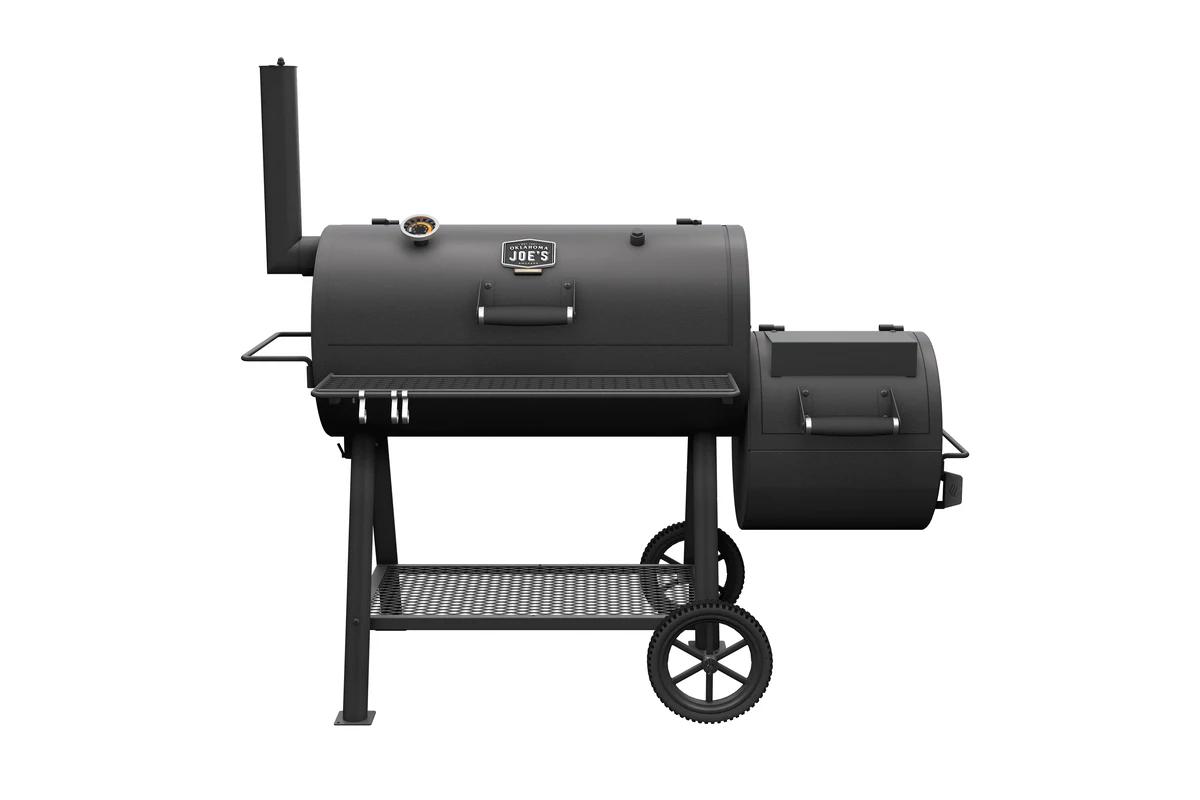
Oklahoma Joe’s Highland Offset Smoker (24203001)
The best first offset, and the best overall pick in our best budget offset smokers guide. It is a true horizontal offset with 879 square inches in total, 616 on the main grate and 263 on the firebox grate, and it weighs 156 lb. A full brisket fits flat on the main grate. The firebox grate doubles as a small grill.
Owners say it leaks smoke and heat out of the box, the factory thermometer reads 25 to 50 degrees off, and the firebox paint peels. A gasket kit and a grate probe fix the worst of it, and the Highland has the biggest mod community of any budget offset. See our best offset smoker mods guide. Assembly takes about 2 hours, faster with help.
Buy it if you want to learn real fire management and work the zones. Skip it if you want set-and-forget cooking.
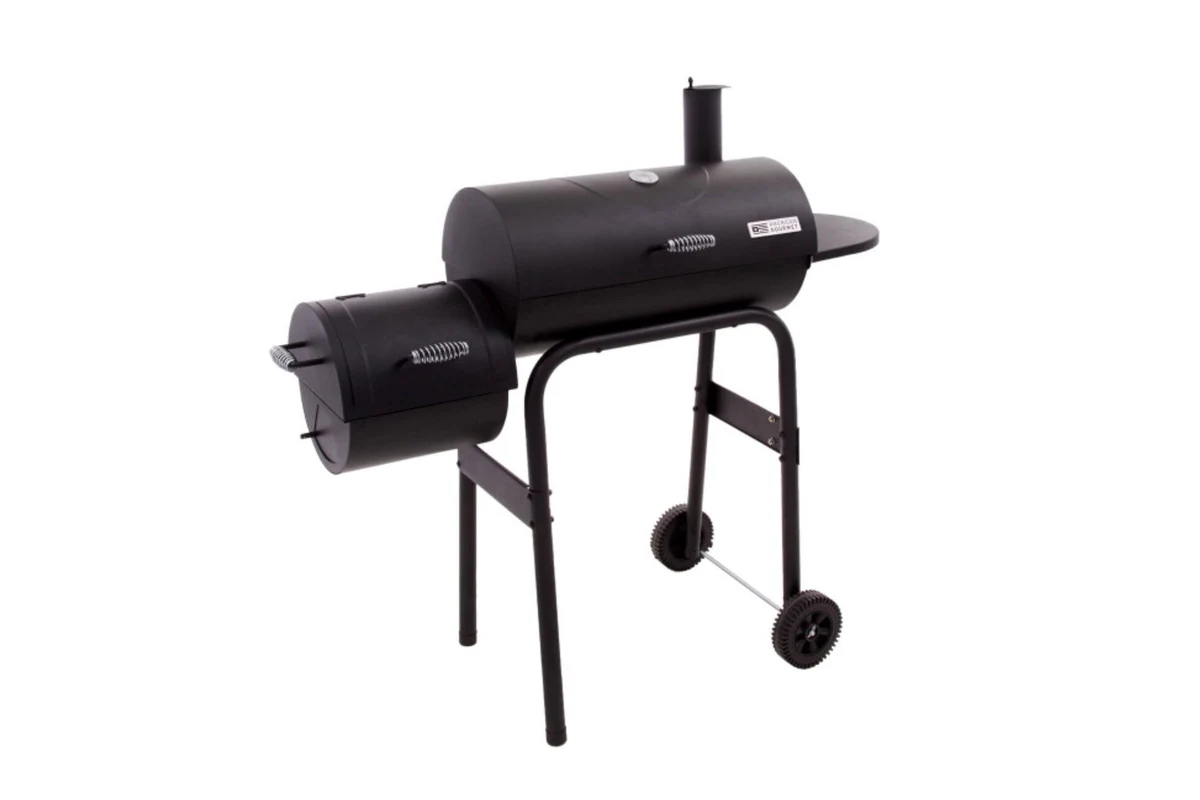
Char-Broil American Gourmet Offset Smoker 430 (12201570-A1)
The smallest true offset in this guide, and the cheapest way into a traditional offset. It gives you 430 square inches in total, 290 on the main grate and 140 on the firebox grate, and it weighs 41 lb, so one person can move it. A full packer brisket does not fit here. It is a starter pit for learning fire management on a small patio. See our best offset smoker under 500 guide for more starter pits at this price.
Owners say the firebox side runs hot while the far side stays cool, and the thin metal makes it hard to hold a steady temperature. The lid leaks smoke until a gasket kit is added, and the thermometer reads off. The small firebox needs charcoal added often on a long cook, and owners report rust at the firebox joint after a few years. Owners also say it is easy to assemble.
Buy it if you want the cheapest way to learn a traditional offset and you cook for two. Skip it if you cook briskets or feed a crowd.
Representative Picks: Reverse Flow Smokers
Representative examples of each type, listed on Amazon, not a tested ranking. We have not hands-on tested them side by side. Both picks can also run as a traditional offset by moving the baffles and the smokestack.
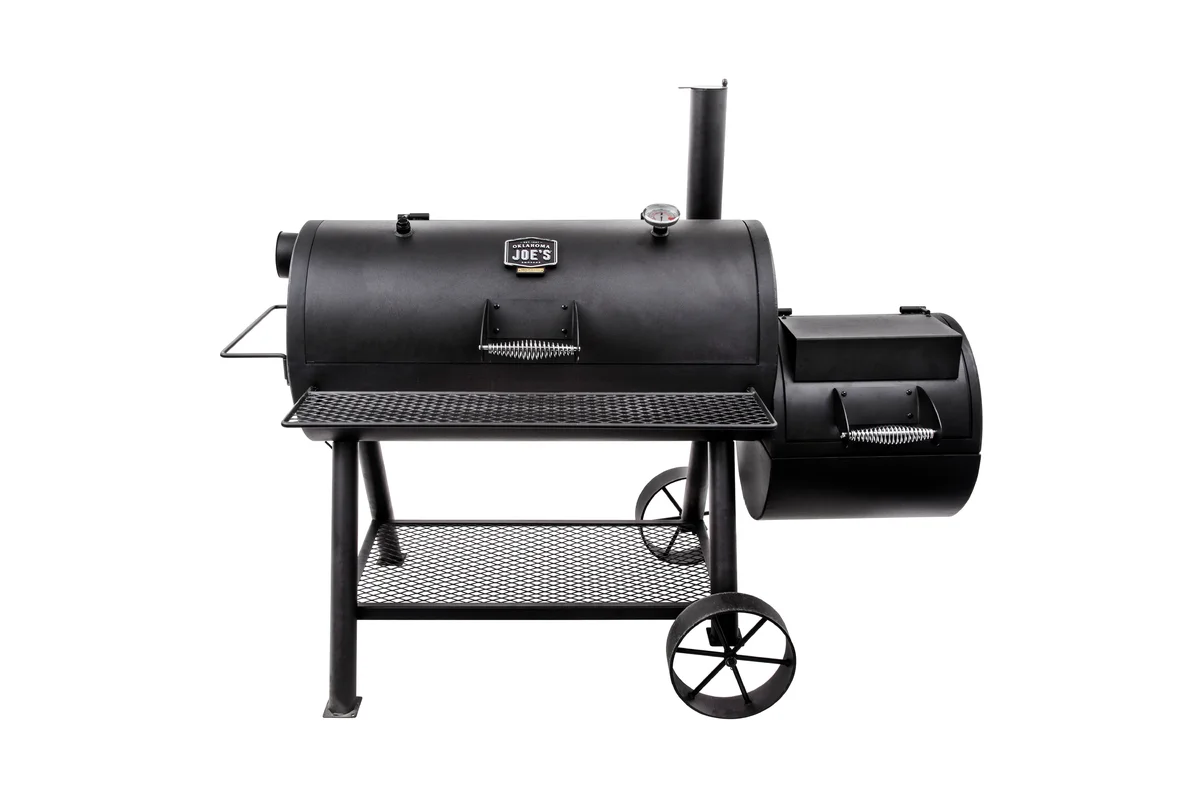
Oklahoma Joe’s Longhorn Reverse Flow Smoker (17202053)
The best overall offset in our flagship guide, and the biggest cooker in this comparison. It gives you 1,060 square inches in total, 751 on the main grate and 309 on the secondary grate, and it weighs 268.3 lb. Four removable baffle plates spread the heat across the chamber, and you can move the baffles and the smokestack to switch it back to a traditional offset. Oklahoma Joe’s gives a 2-year warranty.
Owners praise the even heat across the grates, and one long-term owner says the temperature stays fairly consistent from left to right, more so than any other smoker he has owned. The trade-off is cleaning: the baffles get hot, drippings and food that fall on them burn on, and cleaning under them is the main complaint, according to one long-term owner and a roundup that agrees. Firebox paint peels and blisters, sometimes on the first cook, and the doors and firebox joints leak smoke until a gasket kit is added. The lid thermometer reads off, so use grate-level probes.
Buy it if you fill the whole grate and want everything to finish together. Skip it if you cook for two, have a small patio, or need to move it alone.
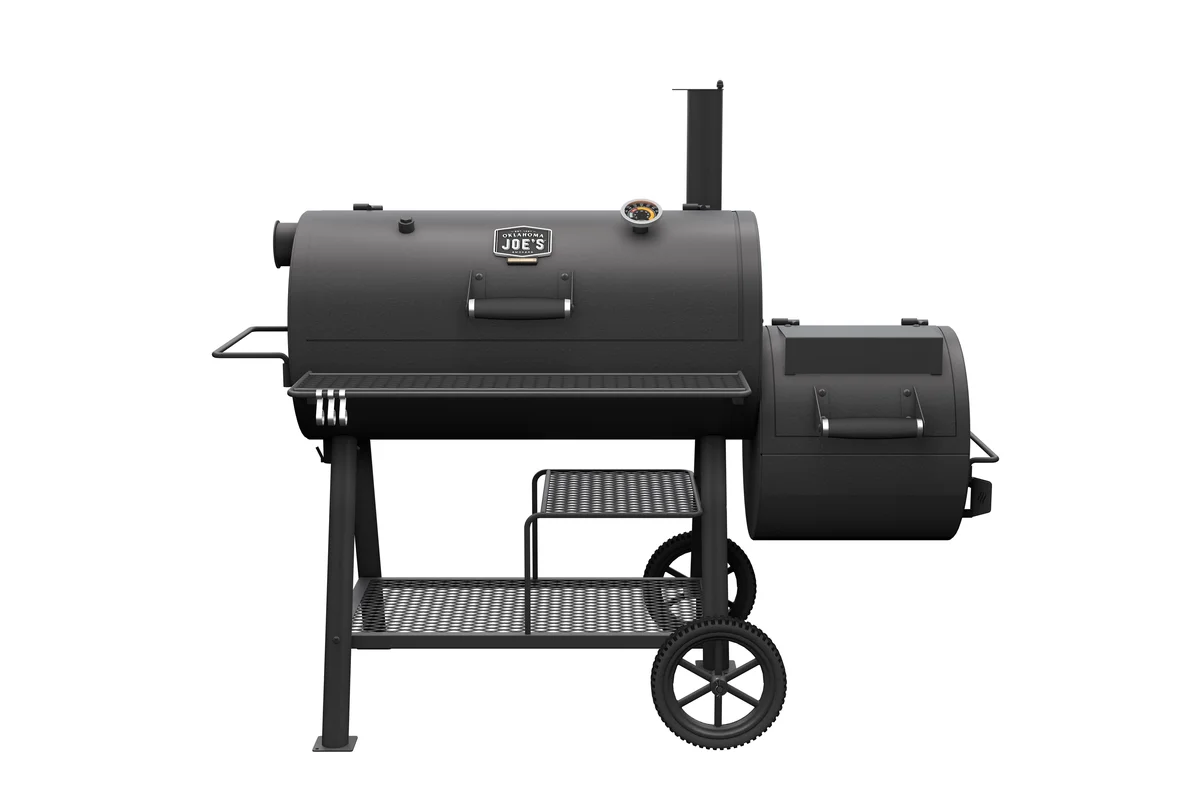
Oklahoma Joe’s Highland Reverse Flow Smoker (24203003)
The value reverse-flow pick, and the matched pair to the Highland. It gives you 1,093 square inches in total, 619 on the primary grate and 281 on the firebox grate, and it weighs 156 lb, the same as the traditional Highland. Four removable baffle plates even out the heat across the grate, and you can move the baffles and the smokestack to switch it back to a traditional offset. Oklahoma Joe’s gives a 2-year warranty. The firebox grate doubles as a small grill.
Owners say it holds temperature well and keeps steady heat, the top note across owner reviews. The firebox paint peels, sometimes on the second use, and rust follows at the firebox after about 6 months, though it has not affected the food owners produce. The drip-pan holes are too small, according to one owner, and the steel is lighter than older Oklahoma Joe’s pits, so it burns charcoal faster and needs more babysitting in cold or wind. It is easy to assemble with clear instructions, and one owner assembled it alone.
Buy it if you want the switchable layout in the smallest, lightest pit. Skip it if you want the most space or the heaviest steel.
Two Comparisons That Belong Elsewhere (Brief Notes)
Two more comparisons belong elsewhere, so brief notes only.
Offset smoker vs kamado grill. A kamado is a thick-walled egg cooker that holds heat for a very long time and can smoke low and sear extremely hot; an offset is a stick-burner built for long, smoky cooks with real fire management. The kamado is the versatile all-rounder, the offset the purist’s smoker. See our offset smoker vs kamado grill comparison.
Offset smoker vs pellet smoker. A pellet smoker is the easiest way to smoke with wood flavor, while an offset needs tending but gives the deepest smoke. See our offset smoker vs pellet smoker comparison.
The Verdict: Which Should You Buy?
Buy reverse flow if: you fill the whole grate with same-size pieces and want them to finish together. Start with the Longhorn Reverse Flow for the most space and even heat, or the Highland Reverse Flow for the switchable layout in the smallest, lightest pit.
Buy traditional if: you cook one or two big cuts, you like working a hot end and a cool end, and you want the strongest direct wood flavor. Start with the Highland, or the Char-Broil 430 if you want the cheapest way in.
Do NOT buy reverse flow if: you cook one brisket at a time and like moving food between zones, or you do not want to clean baffle plates.
Do NOT buy a traditional offset if: you fill the whole grate every cook and want everything to finish at the same time.
The reverse flow smoker vs offset smoker choice comes down to how you cook, not which cooker is better. If you fill the grate and want even heat, buy reverse flow. If you cook a few big cuts and like working the fire, buy traditional. If you are new to offsets, start with our best offset smokers for beginners guide. To compare all the offsets first, read our flagship guide.
Frequently Asked Questions
Is a reverse flow smoker better than a regular offset smoker?
For even heat, yes. The baffle plate evens the grate end to end, so a full grate finishes together. For direct flavor and working zones, no: the traditional layout gives the strongest direct-fire flavor and a hot end and a cool end to work with. They are different jobs, not a better and a worse cooker.
Is a reverse flow smoker still an offset smoker?
Yes. A reverse flow smoker is an offset smoker with a different heat path. The firebox, the fuel and the chamber are the same kind of pit. Only the heat path changes: the baffle plate sends the heat under the grate to the far end and back over the food. People also search “reverse smoker vs offset”, it is the same question, shorter wording. For the full definition, see our what is a reverse flow smoker guide.
Can a reverse flow smoker run as a traditional offset?
The Oklahoma Joe’s picks can. Move the baffles and the smokestack, and the Longhorn Reverse Flow and the Highland Reverse Flow both run as a traditional offset. That is why the buyer is choosing a layout they can switch, not two unrelated machines.
Do reverse flow smokers use more fuel?
No. Both layouts burn charcoal and wood splits in the same kind of firebox, and the baffle adds steel, not fuel. The burn depends on the weather, the wood and how you run the fire, not on the layout.
Which smoker is best for a beginner?
A reverse flow is more forgiving on a full grate, because the heat is even end to end and everything finishes together. A traditional offset rewards patience and teaches real fire management, but it asks you to work the zones on every cook. If you want to learn fire, start with the Highland. Our best offset smokers for beginners guide walks through the choice.
