
Offset Smoker vs Kamado Grill
A kamado grill vs offset smoker comparison comes down to one trade. The offset gives the best wood-fired flavor and the most room, and it needs you tending the fire.
The kamado is the easier cooker to live with. It holds heat for hours on little fuel, and it also grills, roasts and sears. The offset burns wood in a side firebox, and smoke moves through the main chamber.
Pick the offset if you cook for a crowd and love tending a fire. Pick the kamado if you want one cooker that does it all.
As an Amazon Associate, JuicyBurn earns from qualifying purchases made through links on this page, at no extra cost to you.
JuicyBurn has not cooked on these cookers side by side. This comparison is built from manufacturer specifications, Amazon listing details, and what owners say in reviews, forums and roundups. Where the evidence was thin, I say so, and where I could not verify a claim from a second source, I left it out. I ran no hands-on test, and nothing here is presented as my own cook. There is no star rating in this comparison, because I do not score cookers I have not cooked on. Last updated November 28, 2026.
Buy the offset if you cook for a crowd and want the best wood-fired flavor. Buy the kamado if you want one cooker that smokes, grills, roasts and sears with less work. Our lead picks are the Oklahoma Joe’s Highland on the offset side and the Kamado Joe Classic II on the kamado side.
Offset Smoker vs Kamado Grill at a Glance
This comparison chart covers the whole match-up at a glance. The detail follows below it.
| How it makes heat | Offset: Wood fire in a side firebox; heat and smoke flow through the main chamber. Kamado: Charcoal in a fire bowl inside a thick insulated shell. |
| How it makes smoke | Offset: Whole wood splits burning clean. Kamado: Lump charcoal smoldering, plus wood chunks for smoke. |
| Flavor | Offset: Best pure wood-fired smoke flavor. Kamado: Very good smoke, heavier, less clean than an offset. |
| Temperature range | Offset: Low and slow, around 225 degrees F; searing on the firebox grate only. Kamado: 225-750F (Classic II), 200-700F (Akorn); smokes, sears, bakes. |
| Ease of use | Offset: Needs fire tending every couple of hours. Kamado: Set the vents and it holds. |
| Temperature control | Offset: Two dampers, managed by hand; hot near the firebox. Kamado: Two vents, steady once set; an overshoot is slow to correct. |
| Cooking area (our picks) | Offset: 879-1,060 sq in. Kamado: 250-445 sq in. |
| Fuel use | Offset: Burns through splits and charcoal on a long cook. Kamado: Uses noticeably less charcoal once dialed in. |
| What you need to run it | Offset: Charcoal and wood splits, a gasket kit, a grate probe. Kamado: Lump charcoal and a heat deflector (the Akorn’s costs extra). |
| Cleaning | Offset: Clean ash out of the firebox after every cook. Kamado: Ash out of the fire bowl and deflector. |
| Best for | Offset: Big cooks, best smoke flavor, fire lovers. Kamado: One cooker for smoking, grilling, roasting, searing. |
| Weakest point | Offset: Leaks and needs sealing, heavy, needs tending. Kamado: Small cooking area for the size; ceramic can crack, steel can rust. |
Which Tastes Better: Offset or Kamado?
Short answer: the offset, by a clear margin for pure smoke flavor.
An offset smoker burns whole wood splits in a side firebox with plenty of oxygen. That clean wood fire is the flavor other smokers are measured against. The smoke is thin and steady, and it gives brisket and pork shoulder a deep smoke ring and bark.
A kamado burns lump charcoal, and the smoke comes from the charcoal smoldering plus the wood chunks you add. Owners say the smoke is very good, but heavier and less clean than offset smoke. The kamado still makes great barbecue. It just does not taste like a stick burner.
One caveat: a badly run offset tastes worse than a well-run kamado. Dirty smoke from a starved fire bitters the meat.
Which Is Easier to Use?
Short answer: the kamado, day to day.
A kamado is the easier cooker to live with. Set the top and bottom vents and it holds temperature for hours. There is no fire to feed every couple of hours, no splits to add, no damper dance. Owners say the Classic II holds temperature once the vents are set.
An offset asks more of you on every cook. You build the fire, feed it and watch the dampers every couple of hours. That is the work, and it is also the fun for the cooks who love it. A long brisket cook means a long day by the pit.
The kamado has one ease trap: an overshoot is slow to correct, because thick ceramic cools slowly. The Akorn is steel, not ceramic, but one owner warns it can shoot from 400 to 650F in a heartbeat when left wide open, and the only fix is closing the vents and smothering the coals. Set the vents early and in small steps.
How Much Does Each Cost to Run?
Short answer: the kamado costs less to run. The offset burns more fuel on every long cook.
A kamado sips lump charcoal once it is dialed in. Owners say it uses noticeably less charcoal than an offset on the same cook, because the thick shell holds the heat in. That is the running-cost pattern.
An offset burns through fuel. Splits and charcoal go into the firebox all day, more in cold or windy weather, and thin steel loses heat faster. Fuel is the real running cost of offset cooking.
On the Akorn, the charcoal load is capped at 3.1 lb, so plan a top-up on long cooks. For grilling, owners say it is economical: about half a Weber chimney of lump for a meal.
Up front, the pattern flips. A ceramic kamado costs more to buy than a budget offset, because you are paying for thick ceramic, a heavy hinge and a tight seal. The Akorn is the cheap way in. The offset is cheaper to buy and more expensive to run, and the kamado is the reverse.
How Hot Do They Get, and Why It Matters
Short answer: the kamado is the hotter cooker by far. It sears at 750 degrees. The offset is built for low and slow.
The temperature gap. The Kamado Joe Classic II runs from 225 to 750 degrees F, and the Char-Griller Akorn from 200 to 700. That range is the point of a kamado. It smokes low, roasts in the middle, and sears and bakes pizza at the top end, all on the same cooker.
An offset smoker is built to cook low and slow, around 225 degrees. It does not sear in the main chamber, and it does not grill. Searing happens on the firebox grate only.
That gap decides what one cooker can do. The kamado replaces a grill. The offset needs a grill beside it. If you already own a grill, the gap may not matter. If you want one cooker to do both jobs, it matters more than any other difference here.
How Much Food Can You Cook on Each?
Short answer: the offset wins on space, by a lot. Our offset picks give you 879 to 1,060 square inches. Our kamado picks give you 250 to 445.
The capacity gap is the biggest fact in this comparison. The Highland gives you 879 square inches and the Longhorn Reverse Flow 1,060. The Classic II gives you 250 on its main grate, and the Akorn 445 in total. One long offset grate holds a full brisket flat with room to spare. A kamado grate does not.
A full packer brisket fits the offsets. On the Classic II it is tight. Reviewers agree that 250 square inches is tight for a full packer plus sides, and the two-tier Divide and Conquer system helps by splitting the grate into two levels. I do not claim a packer fits or does not fit on the Classic II, because no clean owner report settles it. Treat the Classic II as a family cooker, not a crowd cooker.
Square inches are not all equal. A tall kamado stacks levels, so a full brisket may not lie flat even though the total area looks fair. And do not over-buy: a huge cooker run half-empty uses more fuel than a right-sized one run full.
What About Ceramic vs Offset?
A ceramic grill is a kamado. Ceramic is the material, kamado is the cooker. The thick ceramic shell holds heat for hours on little fuel, and lets the same cooker smoke at 225 degrees and sear at 750.
A steel kamado like the Akorn is the same shape in steel. Triple-wall insulated steel replaces the ceramic, so the cooker is lighter and cheaper, and it still holds heat well. Steel can dent, the finish can chip, and steel rusts if you leave it uncovered. Ceramic can crack if it is knocked or thermally shocked, and it is far heavier. The material is the choice.
Representative Picks: Offset Smokers
Representative examples of each type, listed on Amazon, not a tested ranking. We have not hands-on tested them side by side.
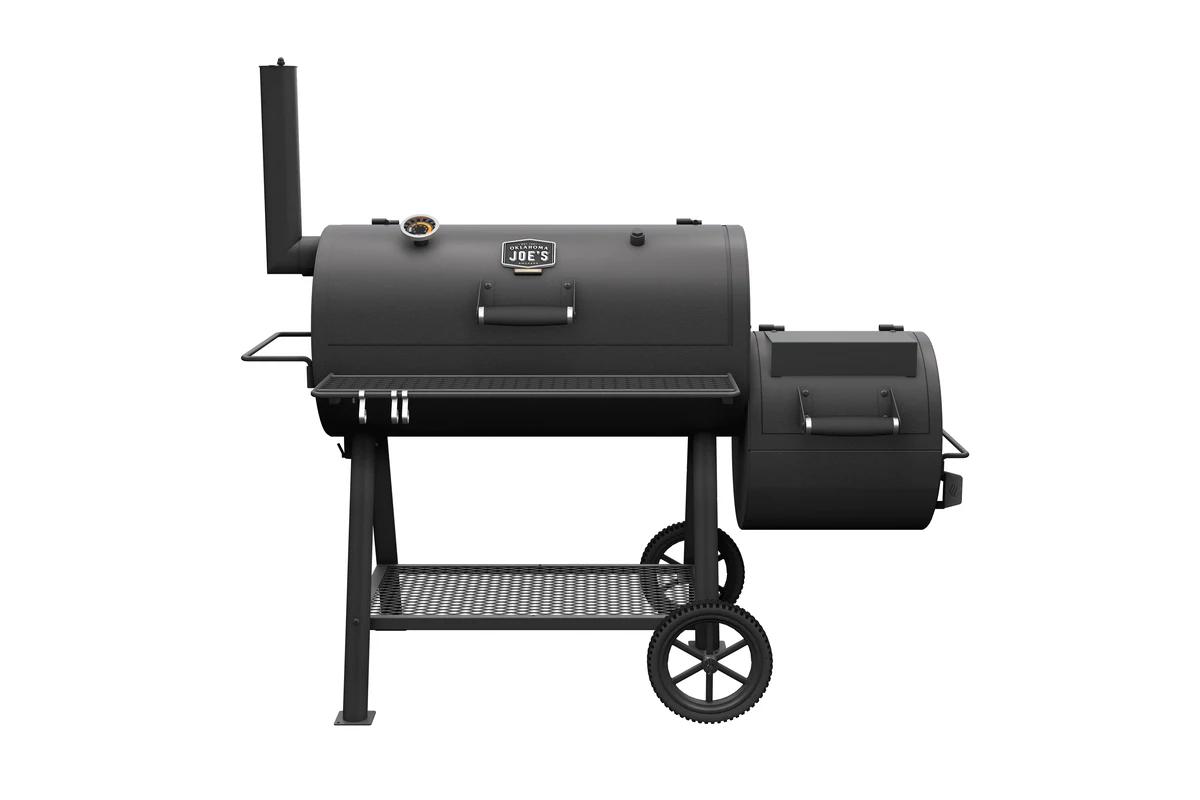
Oklahoma Joe’s Highland Offset Smoker (24203001)
The best first offset, and the best overall pick in our best budget offset smokers guide. It is a true horizontal offset with 879 square inches in total, 616 on the main grate and 263 on the firebox grate, and it weighs 156 lb. A full brisket fits flat on the main grate.
Owners say it leaks smoke and heat out of the box, the factory thermometer reads 25 to 50 degrees off, and the firebox paint peels. A gasket kit and a grate probe fix the worst of it, and the Highland has the biggest mod community of any budget offset. See our best offset smoker mods guide. Assembly takes about 2 hours, faster with help.
Buy it if you want to learn real fire management. Skip it if you want set-and-forget cooking.
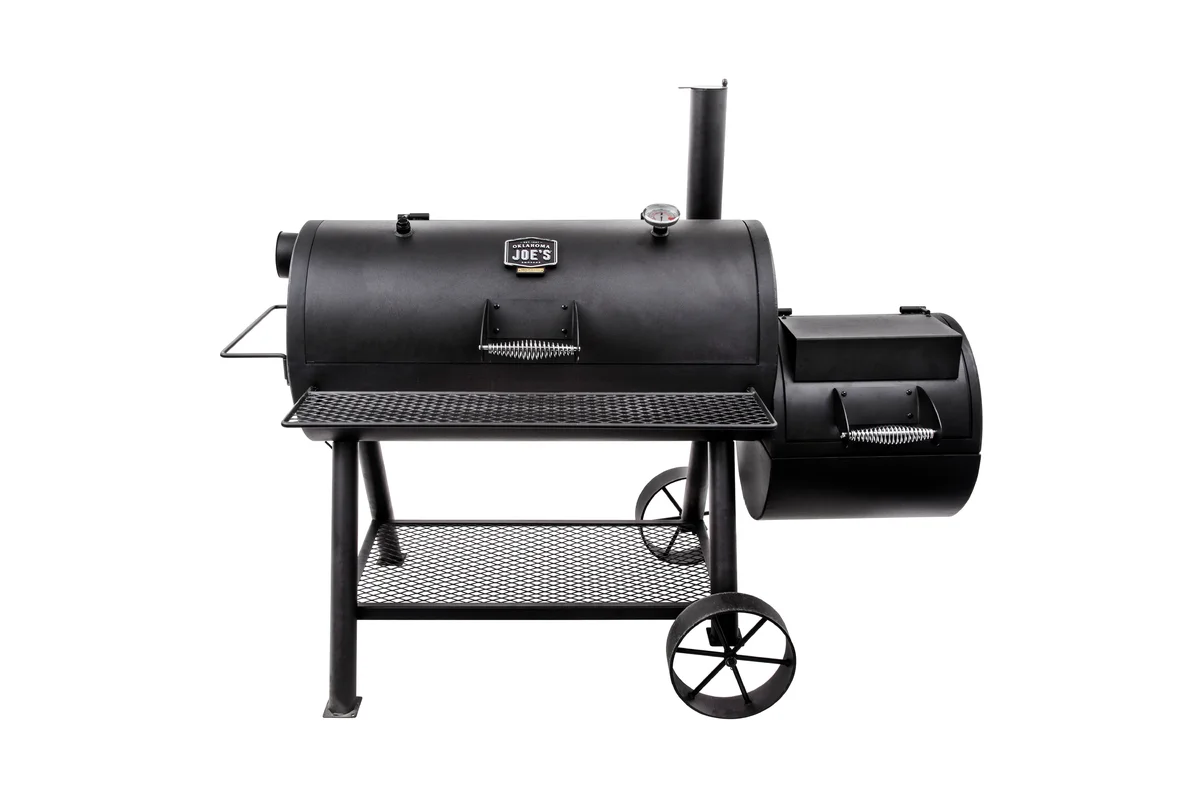
Oklahoma Joe’s Longhorn Reverse Flow Smoker (17202053)
The best overall offset in our flagship guide, and the biggest cooker in this comparison. It gives you 1,060 square inches in total, 751 on the main grate and 309 on the secondary grate, and it weighs 268.3 lb. Four removable baffle plates spread the heat across the chamber, and you can move the baffles and the smokestack to switch it back to a traditional offset. Oklahoma Joe’s gives a 2-year warranty.
Owners say it holds multiple briskets at once, and the baffles mean the far end of the grate cooks close to the firebox end. The trade-off is size and weight. It needs help to move and a large patio, and it needs sealing: owners report gaps at the firebox and the cooking chamber door. Paint can peel on the firebox, the most common complaint, though it does not affect cooking.
Buy it if you cook for a crowd and want the most space and even heat. Skip it if you cook for two or have a small patio.
Representative Picks: Kamado Grills
Representative examples of each type, listed on Amazon, not a tested ranking. We have not hands-on tested them side by side.
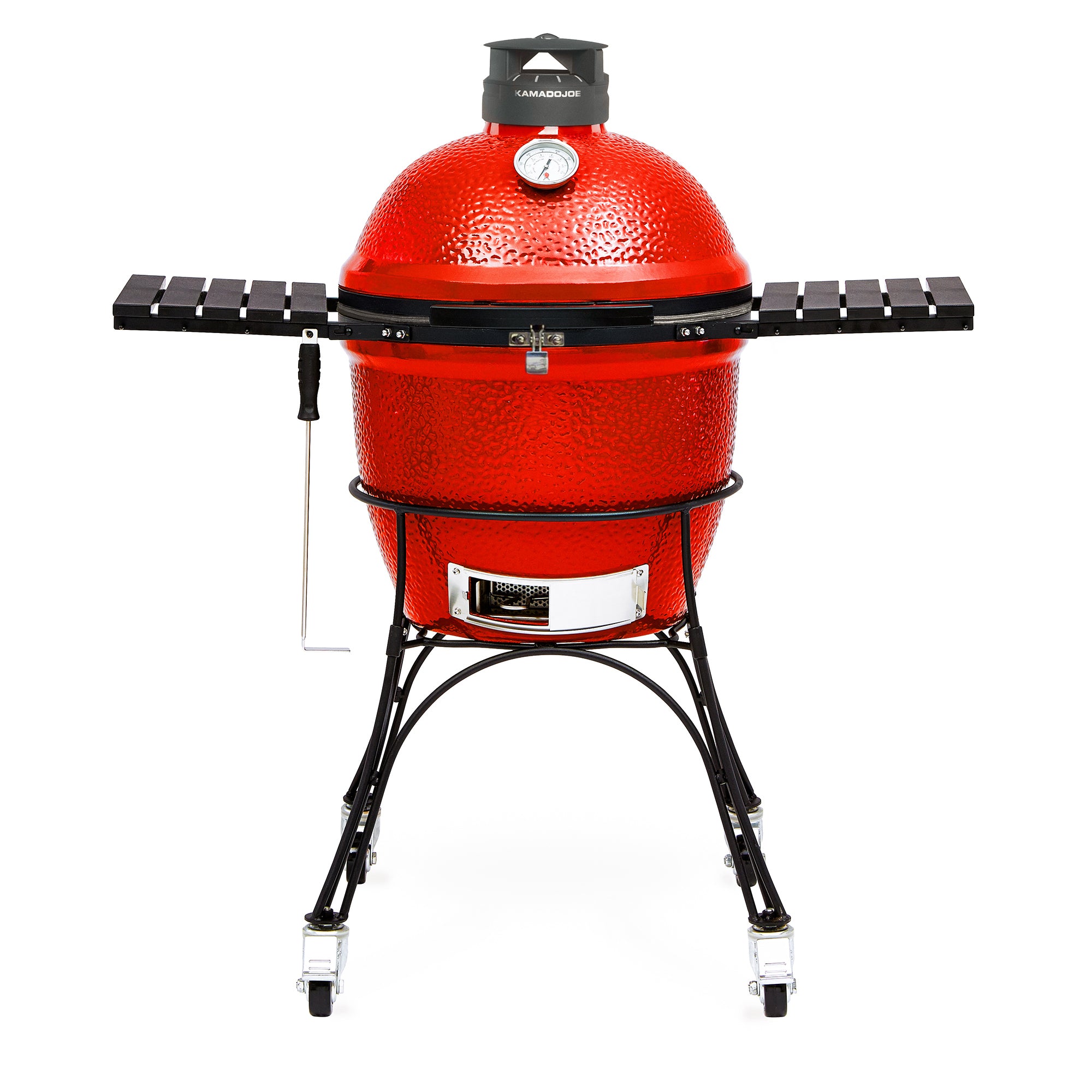
Kamado Joe Classic II (KJ23RHC)
The premium ceramic kamado, and the lead kamado pick in this comparison. It gives you 250 square inches on the main grate, runs from 225 to 750 degrees F, and weighs 232 lb with the cart. The 406 square inch figure you may see elsewhere is with the grill expander fitted, not the grate itself. It has an Air Lift hinge, a Kontrol Tower top vent, an AMP six-piece firebox, and a Divide and Conquer two-tier system. The warranty covers the ceramic for a limited lifetime, metal and cast iron for 5 years, and deflectors and electronics for 3 years.
Owners say it holds temperature once the vents are set, from 225 degree smoking to 750 degree searing on the same cooker. The Air Lift hinge takes the dome’s weight, so lifting it is a one-hand job, though the dome itself is still heavy ceramic. At 232 lb it needs two people to assemble and move, so pick the patio spot before assembly.
The 250 square inch grate is tight for a full packer brisket plus sides. The heat deflector cracks easily and replacements are hard to get, the top complaint in one owner synthesis. The AMP firebox is the maker’s answer to firebox cracking, not deflector cracking. Ceramic can arrive cracked or chipped, so inspect the dome and firebox before discarding the packaging. One owner reports the thermometer reading off and causing overcooking, a single-owner caution, not a pattern.
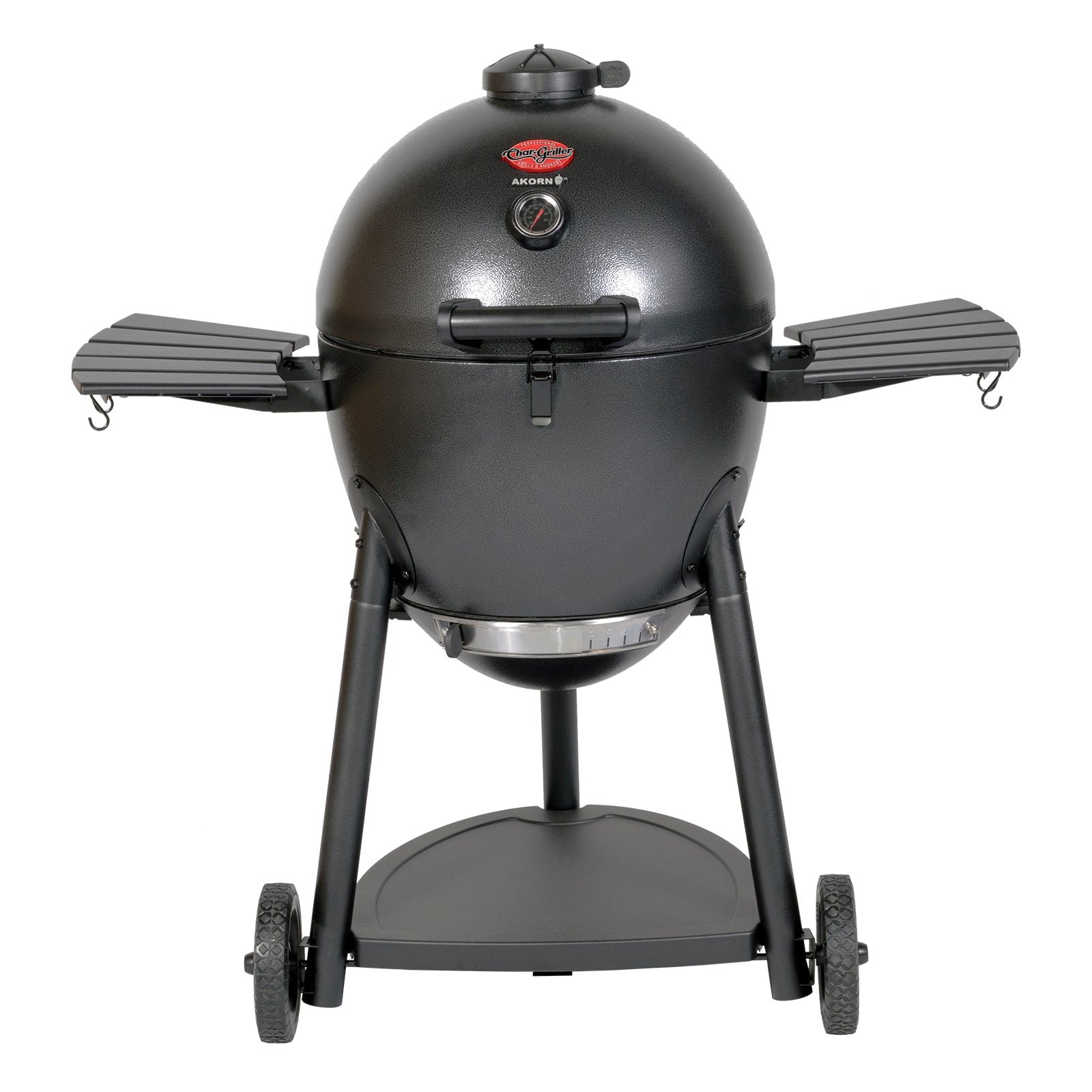
Char-Griller AKORN Kamado (E16620)
The budget way into kamado cooking. This is a steel kamado, not a ceramic one: triple-wall insulated steel in the same egg shape, at a fraction of the weight and cost of ceramic. It gives you 445 square inches in total, 314 on the primary grate and 133 on the warming rack, and it weighs 97 lb. It has cast iron grates, a warming rack and a locking lid, and it runs from 200 to 700 degrees F. The warranty covers the body for 5 years against rust through or burn through, and parts for 1 year; surface rust and paint are not covered.
Owners say it holds 225 degrees through a long pork butt cook with little fiddling, with swings of roughly 15 to 20 degrees, and it is rock-solid at 350 to 400 degrees for roasting. Fuel is economical for grilling: about half a Weber chimney of lump for a meal. But the charcoal load is capped at 3.1 lb, so plan a top-up on long cooks, and the Smokin’ Stone heat deflector costs extra and is not included.
The long-term story is rust. Owners say the cast iron grate arrives rusted and re-rusts even after seasoning, and the steel body can rust in about 3 to 5 years in a harsh climate. Assembly takes a long time, and some hardware needs replacing. One owner warns it overshoots easily and is slow to correct. Keep it covered and clean the ash out after every cook.
Two Comparisons That Belong Elsewhere (Brief Notes)
Three more comparisons belong elsewhere, so brief notes only.
Pellet vs offset. A pellet smoker is a different question: set-and-forget wood-fired cooking with an auger and a fan, against a stick burner you tend by hand. Our offset vs pellet smoker guide is next in the queue.
Big Green Egg vs offset. The famous kamado you cannot buy on Amazon. Big Green Egg sells through its dealer network only, so buy it from Big Green Egg or an authorised dealer.
Offset smoker vs Weber Smokey Mountain. The Smokey Mountain is a bullet smoker, not an offset or a kamado: a vertical charcoal smoker that is small, simple and very good at low and slow. See our best charcoal smokers guide.
The Verdict: Which Should You Buy?
Buy the offset if: you cook for a crowd, you want the best smoke flavor, and you enjoy tending a fire. Start with the Highland, or the Longhorn Reverse Flow for the most space and even heat.
Buy the kamado if: you want one cooker for smoking, grilling, roasting and searing with less daily work. Start with the Classic II, or the Akorn if the Classic II puts you off.
Do NOT buy an offset if: you want set-and-forget cooking, you cook for two, or you have a small patio.
Do NOT buy a kamado if: you regularly cook for a crowd and want the most space for the money, or you want the purest wood-fired flavor. An offset gives you both.
The kamado vs offset smoker choice is not about which cooker is better. It is about which kind of cooking you enjoy. If you love tending a fire and cooking for a crowd, buy the offset. If you want one cooker that does it all with less work, buy the kamado. If you want a smoker that also grills but not a kamado, see our best smoker grill combos guide instead.
Frequently Asked Questions
Is a kamado better than an offset smoker?
No. They are different tools. The offset wins on flavor and space. The kamado wins on ease, versatility and running cost.
Can a kamado replace an offset smoker?
For family cooks, yes. A kamado smokes, grills, roasts and sears on one cooker. For big brisket cooks and pure smoke flavor, no.
Can you sear on an offset smoker?
Only on the firebox grate. The main chamber is built for low and slow cooking, around 225 degrees, so it cannot sear. A kamado sears properly: the Classic II reaches 750 degrees, the Akorn 700.
Is a ceramic grill the same as a kamado?
Yes. Ceramic is the material, kamado is the cooker. A ceramic grill is a kamado with a thick ceramic shell. Steel kamados like the Akorn are the same shape in steel: lighter and cheaper, but they can dent and rust.
Which smoker is best for a beginner?
A kamado is easier to learn: set the vents and it holds temperature, and it forgives a new cook. An offset rewards patience and teaches real fire management, but it asks for tending on every cook. If you want to learn fire, start with the Highland. If you want easy first cooks, start with a kamado. Our best offset smokers for beginners guide walks through the choice.
